HomePracticeJazz BluesC Major

Jazz blues · C major

Jazz blues in C

This is the 12-bar jazz blues form with the ♯iv°7, VI7 and ii–V turnaround that jazz players add to the plain blues — in C, the chords are C7 – F7 – F♯°7 – A7 – Dm7 – G7. In C the blues is C7, F7 and G7 at heart; jazz players add F♯°7 in bar 6 (bass F♯ climbing back to C), A7 in bar 8 to set up the Dm7 – G7 cadence, and a C7 A7 | Dm7 G7 turnaround in the last two bars.

The form

Jazz Blues in C — bar by bar.

12-bar chorus

1C7I⁷
2F7IV⁷
3C7I⁷
4C7I⁷
5F7IV⁷
6F♯°7♯iv°⁷
7C7I⁷
8A7VI⁷
9Dm7ii⁷
10G7V⁷
11C7 · A7I⁷ VI⁷
12Dm7 · G7ii⁷ V⁷

Generic form in Roman numerals — the harmonic skeleton, not any particular tune. Two chords in a bar are two beats each.

Interactive trainer

Hear it, see it, play it — in C major.

Loop
Lead
Tempo110 bpm
I⁷
I7
C7
ArpeggioC · E · G · B♭
Chord-scaleMixolydian  C D E F G A B♭
IV⁷
IV7
F7
ArpeggioF · A · C · E♭
Chord-scaleMixolydian  F G A B♭ C D E♭
♯iv°⁷
♯iv°
F♯°7
ArpeggioF♯ · A · C · E♭
Chord-scaleDiminished (whole–half)  F♯ G♯ A B C D D♯ F
VI⁷
VI7
A7
ArpeggioA · C♯ · E · G
Chord-scaleMixolydian  A B C♯ D E F♯ G
ii⁷
ii
Dm7
ArpeggioD · F · A · C
Chord-scaleDorian  D E F G A B C
V⁷
V
G7
ArpeggioG · B · D · F
Chord-scaleMixolydian  G A B C D E F

Chord-scale on your instrument

Showing: C7 — Mixolydian

Piano · C7 with Mixolydian

B♭B♭CDEFGACDEFGA

Guitar · standard tuning

eBGDAE123456789101112EFGAB♭CDECDEFGAB♭GAB♭CDEFGDEFGAB♭CDAB♭CDEFGAEFGAB♭CDE

Piano · F7 with Mixolydian

E♭B♭E♭B♭CDFGACDFGA

Guitar · standard tuning

eBGDAE123456789101112FGAB♭CDE♭CDE♭FGAB♭GAB♭CDE♭FGDE♭FGAB♭CDAB♭CDE♭FGAFGAB♭CDE♭

Piano · F♯°7 with Diminished (whole–half)

E♭F♯G♯E♭F♯G♯CDFABCDFAB

Guitar · standard tuning

eBGDAE123456789101112FF♯G♯ABCDE♭BCDE♭FF♯G♯ABG♯ABCDE♭FF♯DE♭FF♯G♯ABCDABCDE♭FF♯G♯AFF♯G♯ABCDE♭

Piano · A7 with Mixolydian

C♯F♯C♯F♯DEGABDEGAB

Guitar · standard tuning

eBGDAE123456789101112EF♯GABC♯DEBC♯DEF♯GABGABC♯DEF♯GDEF♯GABC♯DABC♯DEF♯GAEF♯GABC♯DE

Piano · Dm7 with Dorian

CDEFGABCDEFGAB

Guitar · standard tuning

eBGDAE123456789101112EFGABCDEBCDEFGABGABCDEFGDEFGABCDABCDEFGAEFGABCDE

Piano · G7 with Mixolydian

CDEFGABCDEFGAB

Guitar · standard tuning

eBGDAE123456789101112EFGABCDEBCDEFGABGABCDEFGDEFGABCDABCDEFGAEFGABCDE
RootChord toneScale toneBeing played
Play this chord:

Click any chord card to see its scale, and tap any key or fret to hear that note. Turn on “+ Arpeggios” or “+ Scales” and the guitar or piano plays the line live over the vamp, lighting each note on the diagram as it sounds. All audio is synthesized in your browser — nothing is recorded or copyrighted.

Your next 10 minutes

Jazz Blues in C: from chords to a solo

Listen → play → apply
01

Hear the roots

At 60 bpm, first find these chord roots: C, F, F♯, A, D, G. Then play or sing the root of each sounding chord as you follow the trainer. Keep counting through the whole form. If you lose your place, return to roots before adding notes.

02

Connect the guide tones

C7: E and B♭; F7: A and E♭; F♯°7: A and E♭; A7: C♯ and G; Dm7: F and C; G7: B and F. Choose one voice and move to the nearest third or seventh in the next chord. Use your ear; not every transition is a half step.

03

Improvise with a limit

Using the chords C7, F7, F♯°7, A7, Dm7, G7, use only chord tones for one chorus. On the next chorus add a single passing note between targets. Repeat one rhythmic idea, then leave a full bar of space.

Listen for this: Resolve into C7 without rushing. Success means keeping the form and hearing your next target, not reaching the highest tempo.

Understand the sound

Jazz Blues in C: hear the connections

The blues keeps its twelve-bar identity even as the harmony becomes richer. Count the bars first; the passing diminished chord and turnaround should not make you lose the return to I.

A one-note voice-leading study in C; these are pitch targets, not complete chord voicings.
Chord changeOne possible lineMovement
C7 → F7B♭ → ADown 1 semitone
F7 → C7E♭ → EUp 1 semitone
F7 → F♯°7E♭ → E♭Hold the same pitch
F♯°7 → C7E♭ → EUp 1 semitone
C7 → A7B♭ → C♯Up 3 semitones

Build the line before the solo

Play the first pitch in each row during its chord, then move to the target as the next chord begins. Choose an octave that allows the indicated movement. Sing the line once before playing it; add the bass roots only after the upper voice feels secure.

Check that you can hear the form

Stop playing for one complete cycle while you keep counting. Re-enter on C7. If you miss the entrance, simplify to roots and work at 60 bpm before adding passing notes.

Reference

C major Jazz blues — chords, arpeggios & chord-scales.

FunctionChordChord tones (1–3–5–7)Chord-scaleScale notes
I⁷C7C – E – G – B♭MixolydianC D E F G A B♭
IV⁷F7F – A – C – E♭MixolydianF G A B♭ C D E♭
♯iv°⁷F♯°7F♯ – A – C – E♭Diminished (whole–half)F♯ G♯ A B C D D♯ F
VI⁷A7A – C♯ – E – GMixolydianA B C♯ D E F♯ G
ii⁷Dm7D – F – A – CDorianD E F G A B C
V⁷G7G – B – D – FMixolydianG A B C D E F
Guide tonesC7F7F♯°7A7Dm7G7
3rdEAAC♯FB
7thB♭E♭E♭GCF

How to practise this

Build the C major cadence into your ear.

1. Arpeggios in time. Loop the vamp at 70–90 bpm and play C7, F7, F♯°7, A7, Dm7, G7 as 1–3–5–7 quarter notes, one chord per bar. Use the “+ Arpeggios” loop above to hear it played and copy the line.

2. Guide tones. Play only the 3rd and 7th of each chord: E–B♭ → A–E♭ → A–E♭ → C♯–G → F–C → B–F. Notice that F, the 7th of G7, moves to E, the 3rd of C7 — that is the resolution.

3. Chord-scales. Run Mixolydian on C7, Mixolydian on F7, Diminished (whole–half) on F♯°7, Mixolydian on A7, Dorian on Dm7, Mixolydian on G7, then improvise keeping chord tones on beats 1 and 3.

4. Move it. When C is clean, go to F major — a fourth up — and keep going around the circle.
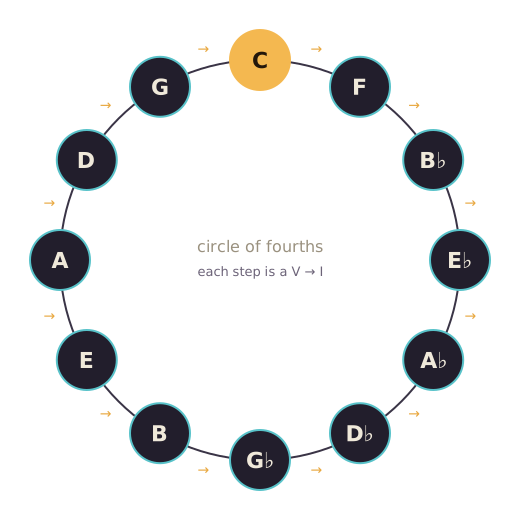
Circle of fourths: C, F, B-flat, E-flat, A-flat, D-flat, G-flat, B, E, A, D, G arranged clockwise, each key a fourth above the last, returning to C
The circle of fourths: from C, the next stop is F. The twelve-keys routine.

Take it to the bandstand.Practice Radio streams this form and every other progression through all twelve keys, with the chord and scale shown live — plus ear-training and call & response modes.

▶ Open Practice Radio

Common questions

C major Jazz blues FAQ.

What are the chords of the Jazz blues in C major?

C7 – F7 – F♯°7 – A7 – Dm7 – G7. The I7 chord is C7 (C, E, G, B♭); The IV7 chord is F7 (F, A, C, E♭); The ♯iv° chord is F♯°7 (F♯, A, C, E♭); The VI7 chord is A7 (A, C♯, E, G); The ii chord is Dm7 (D, F, A, C); The V chord is G7 (G, B, D, F).

Which scales do I play over C7 – F7 – F♯°7 – A7 – Dm7 – G7?

C7: Mixolydian (C D E F G A B♭). F7: Mixolydian (F G A B♭ C D E♭). F♯°7: Diminished (whole–half) (F♯ G♯ A B C D D♯ F). A7: Mixolydian (A B C♯ D E F♯ G). Dm7: Dorian (D E F G A B C). G7: Mixolydian (G A B C D E F).

What is the guide-tone line for the Jazz blues in C major?

The thirds and sevenths: E and B♭ over C7, A and E♭ over F7, A and E♭ over F♯°7, C♯ and G over A7, F and C over Dm7, B and F over G7. Connect each voice to the nearest available third or seventh of the next chord; the distance depends on the progression and voicing.

How should I practise this progression?

Loop the vamp at a slow tempo, play each arpeggio 1–3–5–7 in time, then play each chord-scale up and down, then improvise using only chord tones on the strong beats. When it is clean, move to the next key around the circle of fourths.

All twelve keys

The major Jazz blues in every other key.

Related in C: ii–V–I · turnaround · rhythm changes. Read the theory in Chord-scale theory, or see the scales on their own pages: C Mixolydian, F Mixolydian, F♯ Dim. W–H, A Mixolydian, D Dorian, G Mixolydian.