Chord-scale theory answers one question: which notes can I play over this chord? The answer is a scale — a set of seven (sometimes five, six or eight) notes that contains the chord tones and fills the gaps between them with notes that agree with the chord's colour. Match the scale to the chord and everything you play sits inside the harmony.
Chords and scales are the same thing
Stack a scale in thirds and you get a chord. Spread a chord out stepwise and you get a scale. C△7 is C E G B; add the in-between notes D, F and A and you have C major. That means every chord implies a scale, and every scale contains a chord. Look at the C△7 arpeggio next to C major on the keyboard — the arpeggio is just the scale with the even-numbered notes removed.
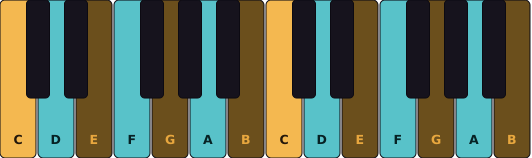
The four chord families and their default scales
| Chord type | Default scale | Example |
|---|---|---|
| △7 (major seventh) | Ionian (major) or Lydian | C major, F Lydian |
| m7 (minor seventh) | Dorian | D Dorian |
| 7 (dominant) | Mixolydian | G Mixolydian |
| m7♭5 (half-diminished) | Locrian | B Locrian |
These four cover most of any chart. All four are modes of one major scale: D Dorian, G Mixolydian and B Locrian are all C major starting from a different note. That is why a ii–V–I feels like one thing — it is one scale, heard from three angles. What is a ii–V–I? walks through that in detail.
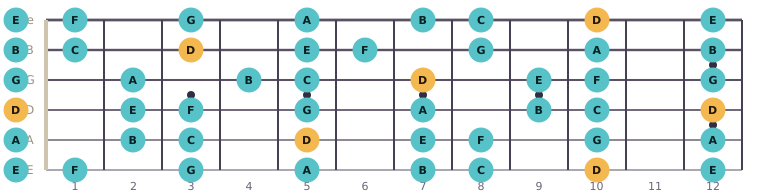
Why not just play the key's scale?
You can. But thinking mode-by-mode keeps the chord tones on the strong beats. If you run D Dorian over Dm7 starting from D, beats 1 and 3 land on D, F, A, C — the chord. Run "C major" from C and beat 1 lands on C, the seventh, which is fine but muddier. Modes are about where you start and what you emphasise, not new notes.
Avoid notes and colour notes
Not every scale note is equal. Over C△7, the F in C major sits a half-step above the third (E) and clashes if you lean on it — the classic avoid note. Two fixes: treat it as a passing note, or swap to C Lydian, which raises it to F♯ — the ♯11 colour you hear all over modern jazz. On a dominant chord the same thinking gives you the altered sounds: G altered has ♭9, ♯9, ♭5 and ♯5 all at once, for when a V7 is heading home and you want it to hurt a little first.
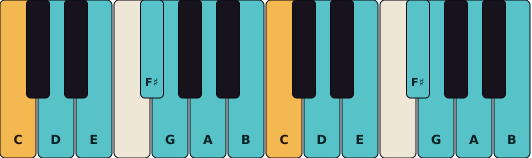
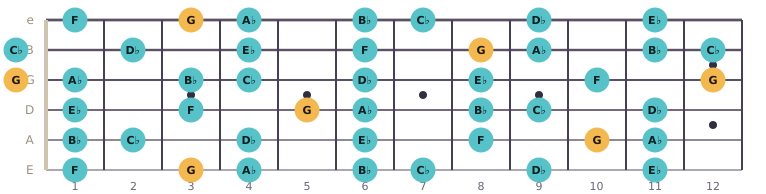
Beyond the defaults
- Dominant options. Mixolydian (plain), Lydian dominant (7♯11, for dominants that don't resolve down a fifth), half–whole diminished (7♭9 and 13♭9), whole tone (7♯5), altered (7alt).
- Minor tonics. Aeolian for the plain minor sound, melodic minor for m△7 and m6, harmonic minor when the V7♭9 is in play.
- Symmetric chords. Whole–half diminished over °7 — the passing chord in a jazz blues or rhythm changes.
- Pentatonics and blues. Major and minor pentatonic have no avoid notes at all, which is why they are so forgiving; the blues scale works over an entire 12-bar form.
A method that sticks
- For any chord, play the arpeggio first (arpeggio library). Chord tones are the skeleton.
- Add the scale around it (scale library) — same root, same instrument page, so you see how the scale wraps the chord.
- Voice it (voicings) so your hands know the sound, not just the theory.
- Put it in a progression and loop it: ii–V–I, turnaround, blues. The trainers show the chord-scale for each chord on piano and guitar while the vamp plays.