Every serious jazz musician says the same thing: learn it in twelve keys. Fewer explain how to do that without spending your life on it. This is a routine that works in twenty minutes a day, because it uses a small amount of material, moves it systematically, and makes you listen more than you read.
Why twelve keys at all
Horn players live in B♭ and E♭ and F; guitarists in E, A, G and D; pianists gravitate to the flat keys. Tunes do not care. A standard in D♭ with a bridge that visits A and E will find every gap in your playing. Twelve-key practice is not about being thorough — it is about never being surprised.
The material: keep it tiny
Do not try to move a whole solo through twelve keys. Move one cell. The best first cell is the ii–V–I, because it contains all three chord families and it is in every tune:
- the three arpeggios (ii, V, I), one octave, up and down;
- the guide-tone line — third and seventh of each chord;
- one short phrase you made up, four bars long, that outlines the changes.
That is the whole kit. Everything below is about moving it.
The order: the circle of fourths
Go up a fourth each time: C → F → B♭ → E♭ → A♭ → D♭ → G♭ → B → E → A → D → G → back to C. Two reasons. First, every V chord resolves up a fourth, so the last chord of one key is a half-step from being the first chord of the next, and the whole cycle feels like music instead of a drill. Second, this order visits the horn keys early and the "hard" sharp keys in the middle, so you cannot postpone them.
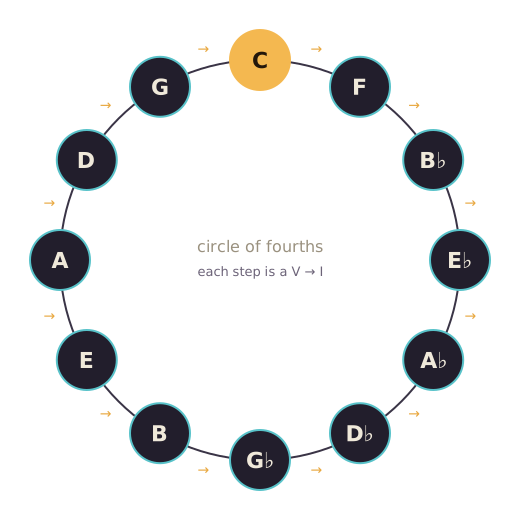
Every tool page on this site carries the next key a fourth up at the bottom, so you can walk the circle without stopping: C → F → B♭ → E♭ → A♭ → D♭ → G♭ → B → E → A → D → G.
The twenty-minute session
- Four keys, five minutes each. Open the key's page, loop the vamp at a tempo where you make no mistakes — 60–80 bpm is honest.
- Minute 1 — arpeggios. Play along with the “+ Arpeggios” loop, then without it.
- Minute 2 — guide tones. Thirds and sevenths only, half notes. Listen for the half-step slides.
- Minute 3 — scales. Dorian, Mixolydian, Ionian, one octave each, in time.
- Minutes 4–5 — your phrase, then improvise. Chord tones on 1 and 3; anything from the chord-scale in between.
Three days covers twelve keys. On the fourth day, play the cell once in every key without stopping, following the circle. That single pass is the test: the keys where you hesitate are next week's first four.
Transpose by ear, not by arithmetic
Counting semitones is slow and it bypasses the ear. Instead, think in scale degrees: your phrase starts on the third of the ii chord, goes to the seventh of the V, lands on the root of the I. Degrees are the same in every key; only the letter names change. The chord cards on every trainer page show the degrees (1–3–5–7) next to the notes for exactly this reason, and the guide-tone table spells the third and seventh of each chord so you can check yourself.
Then widen the cell
When the ii–V–I is automatic, apply the same routine to the next cell — never to more than one at a time:
- The turnaround (I–vi–ii–V): adds the vi chord in front of the ii–V.
- The jazz blues: a whole 12-bar form built from dominants, with a ii–V in bars 9–10.
- Rhythm changes: turnarounds in the A section, a dominant cycle in the bridge.
- Coltrane changes: three keys in four bars — the ultimate twelve-key test.
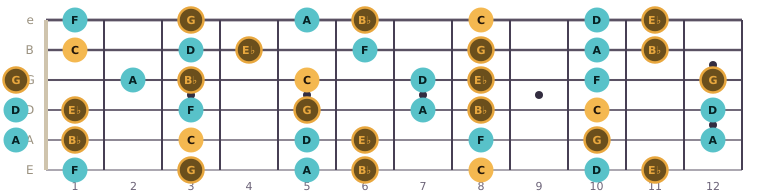
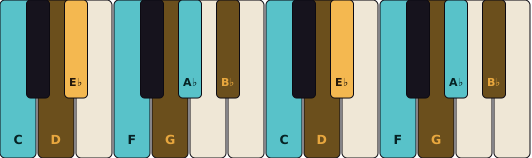
Scales and arpeggios on their own get the same treatment: the scale library and arpeggio library put every one in every key, on guitar and piano, and each page links to the next key round the circle.
Two rules that keep it honest
Slow enough to be clean. Speed comes from clarity, never the other way around. Sing it first. If you can sing the guide-tone line in E, you can play it in E; if you cannot sing it, you are pattern-matching, and the pattern will break on the bandstand.