Almost every jazz standard is built from one small engine: a chain of three chords that pulls toward home. Learn to hear it, spell it in any key and play through it, and the tunes stop looking like a wall of symbols and start looking like a handful of moves you already know.
The three chords
Take a major scale — say C major: C D E F G A B. Build a seventh chord on each degree and you get seven chords. The ii–V–I uses three of them, named by Roman numerals for the scale degree they sit on:
| Degree | Chord in C | Quality | Notes |
|---|---|---|---|
| ii | Dm7 | minor seventh | D F A C |
| V | G7 | dominant seventh | G B D F |
| I | C△7 | major seventh | C E G B |
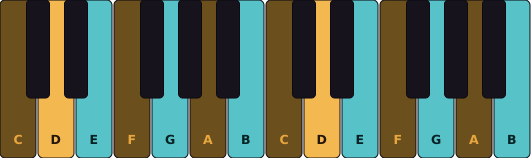
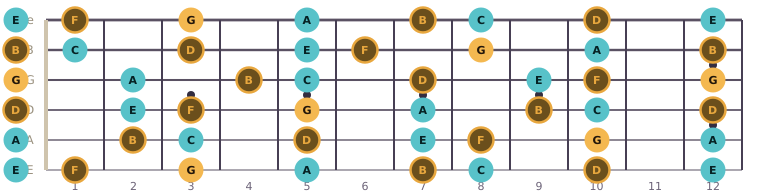
So in C major the progression is Dm7 – G7 – C△7. Hear it now: the ii–V–I in C loops it with a vamp and lights up every chord tone on piano and guitar.
Why it pulls
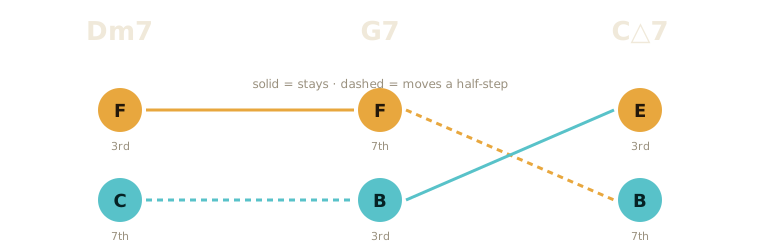
The magic is in the guide tones — the third and seventh of each chord. Those two notes define whether a chord is major, minor or dominant, and across a ii–V–I they move by the smallest possible steps:
F (3rd) → F (7th) → E (3rd)
C (7th) → B (3rd) → B (7th)
One voice holds, the other slides a half-step; then they swap roles. The G7 also contains a tritone (B and F) — the most unstable interval in the scale — and it resolves outward to C and E, the root and third of home. That outward snap is the sound of “resolution” you have heard ten thousand times.
Play only the guide tones over the loop on the F major page (A–E♭, then G–E♭… try it) and you will hear the whole cadence with just two notes per chord.
Which scale goes with which chord
Because all three chords come from the same major scale, one scale technically fits the lot. But jazz players think of each chord as having its own mode of that scale, starting on the chord's root — it keeps the chord tones on the strong beats:
- ii → Dorian. D Dorian over Dm7: the major scale from D to D.
- V → Mixolydian. G Mixolydian over G7: a major scale with a flat seventh.
- I → Ionian. C major over C△7.
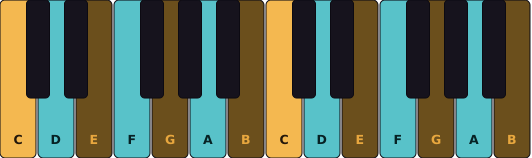
The longer version of this idea is in Chord-scale theory, simply. The arpeggios — Dm7, G7, C△7 — are the skeleton of those scales, and the first thing to get under your fingers.
The minor ii–V–i
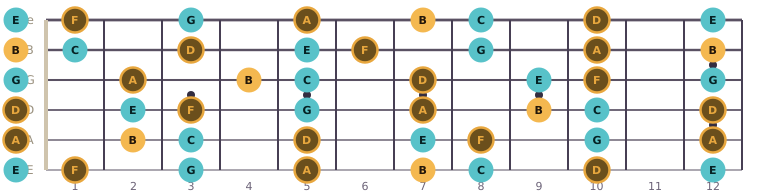
Minor keys have their own version. The ii chord becomes half-diminished (m7♭5), the V picks up a ♭9, and the tonic is minor: in A minor, Bm7♭5 – E7♭9 – Am7. The dominant borrows the raised seventh from harmonic minor (G♯), which is why it sounds darker and more urgent than its major cousin. Compare A minor with C major — same notes, different gravity. The scales change too: Locrian on the iiø, harmonic minor (or its fifth mode) on the V.
Where you will meet it
Everywhere. The last two chords of a turnaround are a ii–V. Bars 9–10 of a jazz blues are a ii–V. Both halves of the A section of rhythm changes are ii–Vs. Once the cell is automatic, long chord charts collapse into a few familiar moves — in different keys, which brings us to the real work.
How to practise it
- One key, slowly. Open B♭ major (the trumpet and tenor key). Loop at 70 bpm. Play each arpeggio 1–3–5–7 in quarter notes, one chord per bar.
- Guide tones only. Third and seventh of each chord, half notes. Listen for the half-step slide.
- Scales in time. Dorian, Mixolydian, Ionian — up and down, eighth notes, staying with the loop.
- Improvise with limits. Chord tones on beats 1 and 3, anything from the scale in between.
- Move a fourth. B♭ → E♭ → A♭ → D♭… around the circle. The keys you avoid are the ones that need it; our guide to practising in twelve keys has a routine.
All twelve major keys: C · F · B♭ · E♭ · A♭ · D♭ · G♭ · B · E · A · D · G. Minor: Am · Dm · Gm · Cm · Fm · B♭m · E♭m · G♯m · C♯m · F♯m · Bm · Em.