Map it slowly
Locate C on white keys and A♭, E♭, G♭, B♭ on black keys. Try each hand separately before playing together; choose a fingering that keeps the wrist relaxed, without stretching between notes.
Arpeggio · A♭9 · Piano
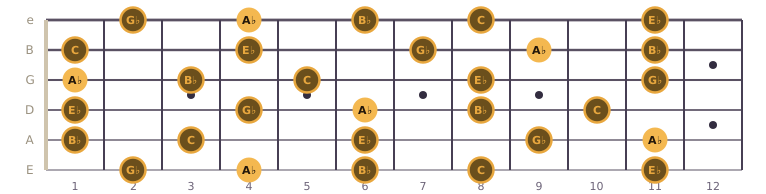
The A♭9 arpeggio is A♭ – C – E♭ – G♭ – B♭ — chord tones 1 3 5 ♭7 9. A♭9 is a fuller V chord; the 9th sits on top of the dominant seventh; its sound is rich, bluesy. Below, every A♭, C, E♭, G♭, B♭ on the two-octave keyboard is marked, with the root in gold. Press play to hear a one-octave arpeggio, or tap any note.
Visualizer
Piano
Guitar · standard tuning
Play loops the arpeggio up and down one octave (switch Loop off for a single pass). Tap any marked note to hear it. “Show” switches or combines the fretboard and keyboard; “Sound” picks the instrument you hear. Audio is synthesized in the browser.
Your next 10 minutes
Locate C on white keys and A♭, E♭, G♭, B♭ on black keys. Try each hand separately before playing together; choose a fingering that keeps the wrist relaxed, without stretching between notes.
Play A♭ – C – E♭ – G♭ – B♭ in quarter notes at 60 bpm. Repeat starting from C, wrapping back to A♭. Do not speed up until every attack is even.
Alternate C and G♭ above a sustained A♭. These are degree 3 and ♭7. End a four-bar phrase on either one instead of always returning to the root.
Listen for this: A♭9 has the colour “rich, bluesy”. Name the degrees as you play, so you can recognize the sound in another key rather than remembering only a shape.
Understand the sound
A ninth extends the dominant seventh; it does not replace the third or seventh. Start with those guide tones, then add the ninth above them.
Here the third is C, and degree ♭7 is G♭. Play A♭ in the bass and compare these voices individually before combining them.
Try C – E♭ – G♭ – A♭ as quarter notes, then repeat the first note and omit the last. The second phrase uses the same harmony with a different shape.
Separate the bass from the upper notes. If the low register sounds muddy, move the upper voices up an octave before adding more notes.
The black-key pitches in this collection are A♭, E♭, G♭, B♭. Use the groups of two and three black keys to orient yourself. Play A♭ and C with each hand separately before combining the hands.
Before moving on, close the diagram and name the notes: A♭ · C · E♭ · G♭ · B♭. Then play a two-bar phrase from memory and leave two bars of silence.
On guitar
Reference
| Chord tone | Note | Interval from A♭ |
|---|---|---|
| 1 | A♭ | unison (0 semitones) |
| 3 | C | major 3rd (4 semitones) |
| 5 | E♭ | perfect 5th (7 semitones) |
| ♭7 | G♭ | minor 7th (10 semitones) |
| 9 | B♭ | major 9th (14 semitones) |
Goes with: A♭ Mixolydian (A♭ B♭ C D♭ E♭ F G♭). Voicings: see the four-note chord voicings in the chord library.
Take it to the bandstand.Practice Radio streams endless changes to play the A♭9 arpeggio over through all twelve keys, with the chord and scale shown live — plus ear-training and call & response modes.
▶ Open Practice RadioCommon questions
A♭ – C – E♭ – G♭ – B♭. As chord tones: 1 3 5 ♭7 9. Played one after another instead of together, that is the arpeggio.
A♭9 is a fuller V chord; the 9th sits on top of the dominant seventh. Its character is rich, bluesy.
A♭ Mixolydian (A♭ B♭ C D♭ E♭ F G♭) — the arpeggio is the skeleton of that scale, so practise them together.
Play A♭ – C – E♭ – G♭ – B♭ ascending from A♭, then descend; then start from each chord tone in turn (inversions) so your hand knows the shape from any note.
Keep going
Same arpeggio on guitar · Dominant 9th hub · chord-scale theory.
Other arpeggios from A♭