Build the sound
Play G – B♭ – D♭ – F♭ individually, then choose a shell voicing above. Sing the highest note before playing the chord.
Voicings · G°7 · Guitar
G°7 is spelled G – B♭ – D♭ – F♭ (1 ♭3 ♭5 𝄫7) — passing chords between diatonic chords, and as a 7♭9 without its root. Here are 3 ways to voice it on guitar: drop 2, drop 3, shell. Every diagram is playable — press play to hear the chord, or “roll it” to hear the voices one by one, low to high.
The voicings
Take the close voicing and drop its second-highest voice an octave. The most-used four-note voicing on guitar and in piano left hands. Strings A-D-G-B, frets 4-5-3-5 (position 1).
Drop the third-highest voice of the close voicing an octave: a wide, open sound. Strings E-D-G-B, frets 6-5-6-5 (position 2).
Root, seventh and third only. The fifth is dropped — it adds nothing to the chord's identity — leaving a light, clear voicing. Strings E-D-G, frets 3-2-3.
Your next 10 minutes
Play G – B♭ – D♭ – F♭ individually, then choose a shell voicing above. Sing the highest note before playing the chord.
Compare the displayed voicings of G°7. Notice which note is highest in each. Repeat the two shapes with the smallest comfortable hand movement, leaving a beat of silence between them.
Play G°7 on beats 2 and 4 at 60 bpm for four bars, then on the “and” of beat 2 for four bars. Keep the same notes while changing the rhythm. Mute unused strings and test each fretted note for buzz.
Listen for this: The chord tones are G, B♭, D♭, F♭. passing chords between diatonic chords, and as a 7♭9 without its root. A fuller voicing is not automatically better: leave room for the melody and bass.
Understand the sound
Successive chord tones are separated by minor thirds. The seventh is a diminished seventh, not a major sixth in the chord’s theoretical spelling, even when they share a piano key.
Here the third is B♭, and degree 𝄫7 is F♭. Play G in the bass and compare these voices individually before combining them.
Start with the smallest displayed shape you can play cleanly. Move its highest note into a comfortable register and listen for a clear melody above the chord.
Sound the strings separately before playing them together. If a note is muted, adjust the finger angle instead of squeezing harder.
Start with G on string 6, fret 3. The next note B♭ is on string 6, fret 6. Name both notes aloud before playing, then find the same two pitches in another octave.
Before moving on, close the diagram and name the notes: G · B♭ · D♭ · F♭. Then play a two-bar phrase from memory and leave two bars of silence.
Behind the voicings
Reference
| Chord tone | Note | Interval |
|---|---|---|
| 1 | G | unison |
| ♭3 | B♭ | minor 3rd |
| ♭5 | D♭ | diminished 5th |
| 𝄫7 | F♭ | diminished 7th |
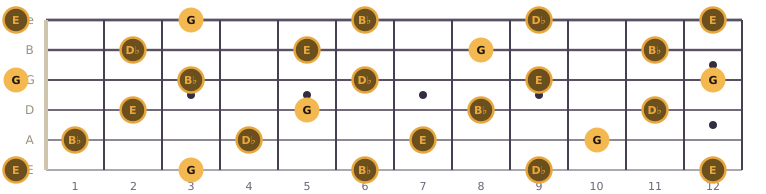
Arpeggio: G°7 arpeggio on guitar. Scale: G Diminished (whole–half).
Take it to the bandstand.Practice Radio streams endless changes to comp G°7 through all twelve keys, with the chord and scale shown live — plus ear-training and call & response modes.
▶ Open Practice RadioCommon questions
G, B♭, D♭, F♭ — chord tones 1 ♭3 ♭5 𝄫7.
The shell voicing (root, seventh, third) on strings E, D, G: three notes, one comfortable shape, and it still sounds unmistakably like G°7.
Start from the close voicing G B♭ D♭ F♭ and drop the second note from the top an octave: D♭ – G – B♭ – F♭. It spreads the chord so it fits the hand — and on guitar it fits four adjacent strings.
G°7 is passing chords between diatonic chords, and as a 7♭9 without its root. Its character is symmetrical, restless.
Keep going
Same chord on piano · Diminished 7th hub.
Other chords from G