Map it slowly
Find A on string 6 at fret 5. Play string 6, fret 5; string 6, fret 9; string 5, fret 8; string 4, fret 5; string 4, fret 7. Use a relaxed position and release pressure between repetitions. String 1 is high E.
Arpeggio · A7♯5 · Guitar
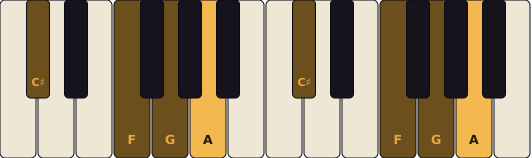
The A7♯5 arpeggio is A – C♯ – E♯ – G — chord tones 1 3 ♯5 ♭7. A7♯5 is a dominant that wants extra tension before resolving down a fifth; its sound is floating, whole-tone. Below, every A, C♯, E♯, G on the fretboard is marked, with the root in gold. Press play to hear a one-octave arpeggio, or tap any note.
Visualizer
Guitar · standard tuning
Piano
Play loops the arpeggio up and down one octave (switch Loop off for a single pass) in the position starting at fret 5. Tap any marked note to hear it. “Show” switches or combines the fretboard and keyboard; “Sound” picks the instrument you hear. Audio is synthesized in the browser.
Your next 10 minutes
Find A on string 6 at fret 5. Play string 6, fret 5; string 6, fret 9; string 5, fret 8; string 4, fret 5; string 4, fret 7. Use a relaxed position and release pressure between repetitions. String 1 is high E.
Play A – C♯ – E♯ – G in quarter notes at 60 bpm. Repeat starting from C♯, wrapping back to A. Do not speed up until every attack is even.
Alternate C♯ and G above a sustained A. These are degree 3 and ♭7. End a four-bar phrase on either one instead of always returning to the root.
Listen for this: A7♯5 has the colour “floating, whole-tone”. Name the degrees as you play, so you can recognize the sound in another key rather than remembering only a shape.
Understand the sound
The raised fifth changes the dominant’s centre of gravity. Keep the major third and flat seventh clear while you listen to the altered fifth.
Here the third is C♯, and degree ♭7 is G. Play A in the bass and compare these voices individually before combining them.
Try C♯ – E♯ – G – A as quarter notes, then repeat the first note and omit the last. The second phrase uses the same harmony with a different shape.
Sound the strings separately before playing them together. If a note is muted, adjust the finger angle instead of squeezing harder.
Start with A on string 6, fret 5. The next note C♯ is on string 6, fret 9. Name both notes aloud before playing, then find the same two pitches in another octave.
Before moving on, close the diagram and name the notes: A · C♯ · E♯ · G. Then play a two-bar phrase from memory and leave two bars of silence.
On piano
Reference
| Chord tone | Note | Interval from A |
|---|---|---|
| 1 | A | unison (0 semitones) |
| 3 | C♯ | major 3rd (4 semitones) |
| ♯5 | E♯ | augmented 5th (8 semitones) |
| ♭7 | G | minor 7th (10 semitones) |
Goes with: A Whole tone (A B D♭ E♭ F G). Voicings: A7♯5 voicings on guitar.
Take it to the bandstand.Practice Radio streams endless changes to play the A7♯5 arpeggio over through all twelve keys, with the chord and scale shown live — plus ear-training and call & response modes.
▶ Open Practice RadioCommon questions
A – C♯ – E♯ – G. As chord tones: 1 3 ♯5 ♭7. Played one after another instead of together, that is the arpeggio.
A7♯5 is a dominant that wants extra tension before resolving down a fifth. Its character is floating, whole-tone.
A Whole tone (A B D♭ E♭ F G) — the arpeggio is the skeleton of that scale, so practise them together.
Start on the root A on the low E string at fret 5 and play E-string fret 5, E-string fret 9, A-string fret 8, D-string fret 5, D-string fret 7. Then play it descending, then in eighth notes with a metronome, then use it in a short phrase over a suitable chord.
Keep going
Same arpeggio on piano · Augmented 7th (7♯5) hub · chord-scale theory.
Other arpeggios from A