Map it slowly
Locate D, F, C on white keys and E♭, G♭, A♭, B♭ on black keys. Try each hand separately before playing together; choose a fingering that keeps the wrist relaxed, without stretching between notes.
Altered · D · Piano
The D Altered scale is D E♭ F G♭ A♭ B♭ C — formula 1 ♭2 ♭3 ♭4 ♭5 ♭6 ♭7, step pattern H–W–H–W–W–W–W. Use it over D7alt: it is the scale for altered dominant chords (7♭9, 7♯9, 7♯5, 7♭13) resolving to a tonic — the V7alt in a ii–V–I. Below, every note is marked on the two-octave keyboard; press play to hear it on a synthesized piano while each note lights up, or tap any key to sound that note.
Visualizer
Piano
Guitar · standard tuning
Tap any note on the diagram to hear it. Play loops the scale up and down one octave in eighth notes (switch Loop off for a single pass). “Show” switches or combines the fretboard and keyboard; “Sound” picks the instrument you hear. Audio is synthesized in the browser.
Your next 10 minutes
Locate D, F, C on white keys and E♭, G♭, A♭, B♭ on black keys. Try each hand separately before playing together; choose a fingering that keeps the wrist relaxed, without stretching between notes.
Play D – E♭ – F as two eighth notes and a quarter note, then rest for two beats. Answer with C – B♭ – A♭. Use the space to hear the phrase before repeating it.
Hold or repeat D as a drone. Play each note of D Altered above it, pausing on E♭ and C. Compare their tension with the root. Then improvise using only three notes and two rhythms.
Listen for this: altered dominant chords (7♭9, 7♯9, 7♯5, 7♭13) resolving to a tonic — the V7alt in a ii–V–I. Treat the scale as a palette, not a requirement to play every note. If a note clashes with a chord or melody, resolve it deliberately or leave it out.
Understand the sound
This sound gathers altered tensions around a dominant chord. Its theoretical flat fourth sounds like the major third; chord-symbol spelling often describes the same pitches differently.
In D Altered, degree ♭5 is A♭. Play D, then A♭, then D again. Sing the middle note before touching the instrument.
A plain fifth or natural ninth from Mixolydian changes the colour. Choose tensions deliberately, then resolve them into the next chord.
Slow the player to 60 bpm. Record one short phrase and check whether its ending sounds deliberate. Increase the tempo only when you can repeat it without losing the pulse.
Shared pitches: D, G♭, C. Pitches in D Altered outside the comparison scale: E♭, F, A♭, B♭. Compare the sounds over the same root, at the same tempo.
Play D Mixolydian on piano →The black-key pitches in this collection are E♭, G♭, A♭, B♭. Use the groups of two and three black keys to orient yourself. Play D and E♭ with each hand separately before combining the hands.
Before moving on, close the diagram and name the notes: D · E♭ · F · G♭ · A♭ · B♭ · C. Then play a two-bar phrase from memory and leave two bars of silence.
On guitar
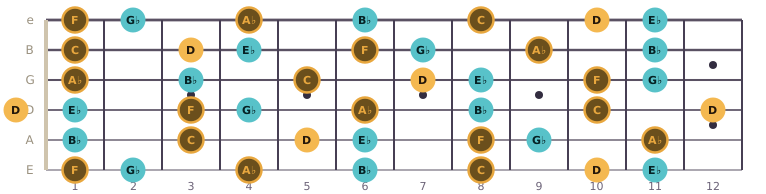
Reference
| Degree | Note | Interval from D | Step to next |
|---|---|---|---|
| 1 | D | unison (0 semitones) | H |
| ♭2 | E♭ | minor 2nd (1 semitones) | W |
| ♭3 | F | minor 3rd (3 semitones) | H |
| ♭4 | G♭ | diminished 4th (4 semitones) | W |
| ♭5 | A♭ | diminished 5th (6 semitones) | W |
| ♭6 | B♭ | minor 6th (8 semitones) | W |
| ♭7 | C | minor 7th (10 semitones) | W |
Chord it implies: D7alt (D – F – A♭ – C). Use it for: altered dominant chords (7♭9, 7♯9, 7♯5, 7♭13) resolving to a tonic — the V7alt in a ii–V–I.
Take it to the bandstand.Practice Radio streams endless changes to play D Altered over through all twelve keys, with the chord and scale shown live — plus ear-training and call & response modes.
▶ Open Practice RadioCommon questions
D E♭ F G♭ A♭ B♭ C. As scale degrees: 1 ♭2 ♭3 ♭4 ♭5 ♭6 ♭7. It has 7 notes.
D Altered fits D7alt and, more generally, altered dominant chords (7♭9, 7♯9, 7♯5, 7♭13) resolving to a tonic — the V7alt in a ii–V–I.
1 ♭2 ♭3 ♭4 ♭5 ♭6 ♭7 — the step pattern from the root is H W H W W W W (W = whole step, H = half step).
Play D E♭ F G♭ A♭ B♭ C D ascending from the root, then descend. The keyboard above shows every root in gold, chord tones outlined in amber and the remaining scale tones in teal; use the Play button to hear the fingering tempo.
Keep going
Same scale on guitar · all Altered pages: Altered hub · theory: chord-scale theory.
Other scales from D